8 Precision Glass Products from Our OEM Portfolio
Quartz glass discs are custom-fabricated, not generic catalog stock. The eight production programs below show the printed glass, flat-panel, coating, edge-finishing and touch-cover disciplines already controlled in our factory. Product URLs are preserved exactly. If your quartz glass disc drawing has no direct match, use the Inquire Now button for a specification review.



Quartz Glass Discs: A Material and Metrology Problem, Not a Commodity
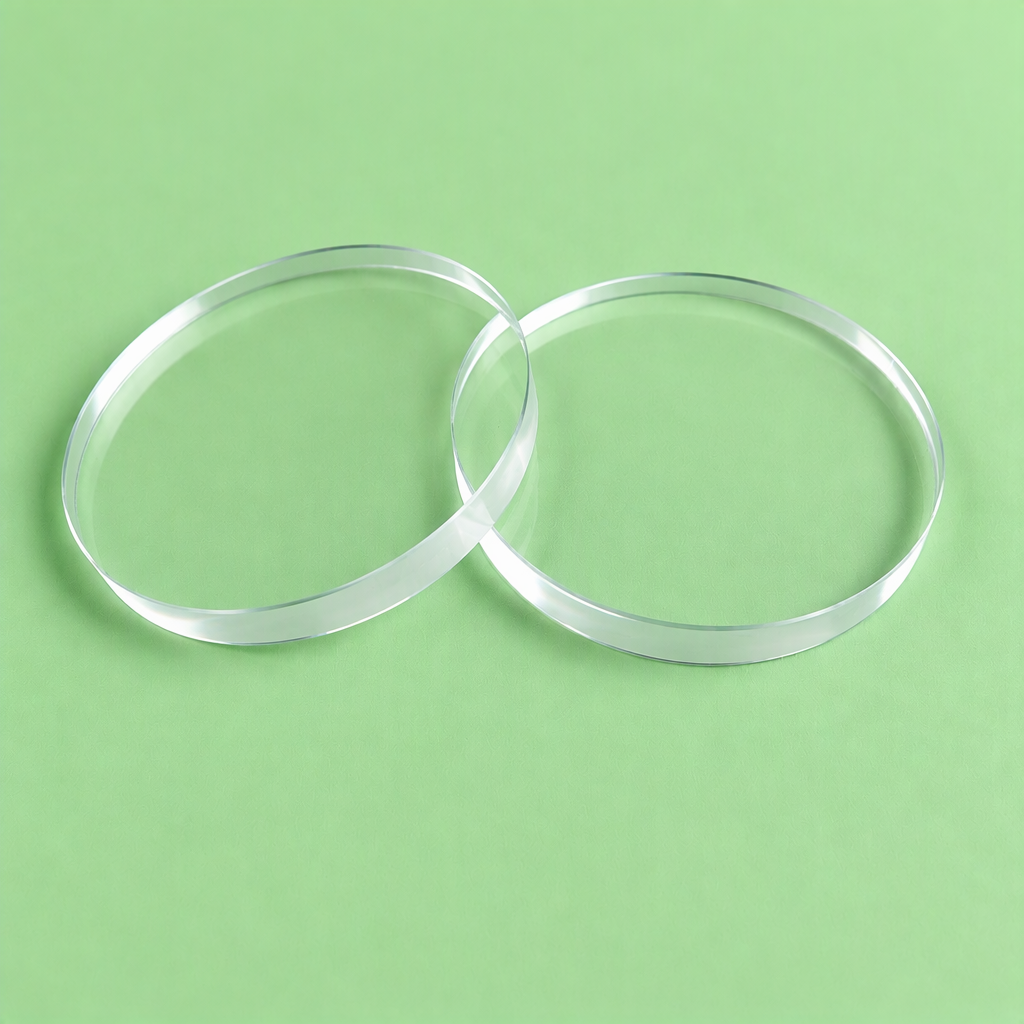
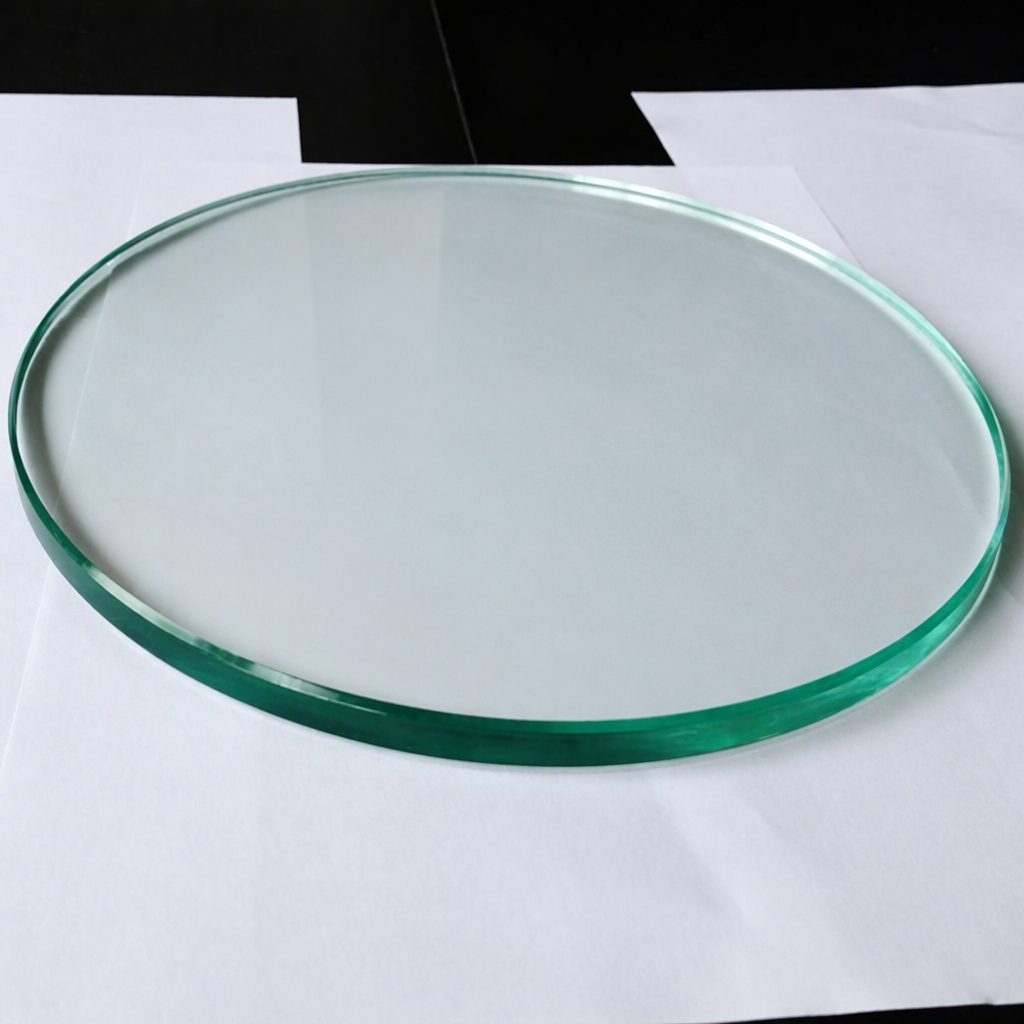
A quartz glass disc is a precision SiO2 component, usually produced from fused quartz or fused silica. Wholesale buyers get the best result when they specify the grade, optical function, thermal environment and inspection method before price negotiation begins.
Fused quartz and fused silica discs are selected for low thermal expansion, high optical transmission, electrical insulation and chemical inertness. In optics, analytical instruments, semiconductor tools, high-temperature viewports and medical diagnostics, the disc is often a small part of the bill of materials but a major determinant of yield. Diameter, thickness, OH content, bubble and inclusion limits, transmittance range, flatness, parallelism, edge finish, coating and cleaning method all affect whether a quotation becomes a repeatable production program.
The highest-value question in a quartz glass disc RFQ is not “what is the price per piece?” but “which material grade and inspection class does the application actually require?” A UV-grade optical disc, a low-OH high-temperature disc and a general-purpose laboratory disc can look similar on a drawing, yet behave differently after polishing, coating or thermal cycling. Another frequent specification gap is tempering language. Fused quartz discs are normally annealed to relieve stress rather than thermally tempered for safety fragmentation. If a drawing says “tempered quartz glass,” clarify whether the real requirement is thermal shock resistance, strength, flatness stability or fragment behavior before quoting.
High-Purity SiO2 Selection
Grade selection controls bubbles, inclusions, OH content and trace contamination. For optical or semiconductor use, request raw-material certificates and lot traceability rather than accepting a generic “quartz” description.
Low Thermal Expansion
Fused quartz offers very low thermal expansion, making it attractive for high-temperature fixtures and optical paths. The fixture design, clamping and annealing history still determine whether that material advantage survives assembly.
Optical Transmission
Transmission from UV to IR depends on grade, thickness and surface quality. Specify wavelength range, target transmittance, coating and measurement method so that “clear quartz” becomes a verifiable optical requirement.
Thermal Shock Discipline
Quartz glass discs can handle demanding thermal cycles, but performance depends on edge quality, stress state and mounting. Avoid mixing thermal-shock claims with tempering claims unless the test method and failure mode are defined.
Electrical Insulation
High resistivity and dielectric strength make quartz discs useful in insulated windows, sensor covers and high-voltage equipment. Cleanliness and surface moisture control are as important as bulk material data.
Chemical Inertness
Quartz resists many acids and process chemicals, but hydrofluoric acid and certain etchants still require special handling. Specify cleaning chemistry, packaging and allowable surface marks for laboratory and medical discs.
Fused Quartz vs. Borosilicate vs. Soda-Lime: Select the Disc by Function
Do not select a material from a single word on a drawing. Compare thermal, optical and cost requirements together. Typical values below are for early-stage sourcing and must be confirmed against the supplied grade certificate and application test plan.
| Selection Factor | Fused Quartz / Fused Silica Disc | Borosilicate Glass Disc | Soda-Lime Glass Disc |
|---|---|---|---|
| Typical SiO2 content | Very high purity SiO2; grade dependent | Approximately 80% SiO2 with boron oxide | Lower silica content with sodium and calcium oxides |
| Thermal expansion | Very low; excellent dimensional stability | Moderate; good for lab glassware | Higher; less suited to rapid thermal cycling |
| Thermal shock | Excellent when grade, edge and mounting are correct | Good for many laboratory applications | Limited; risk increases with thickness and restraint |
| Optical use | UV to IR capability depending on grade and OH content | Visible and near-IR; economical optical windows | General visible use; not a high-end optical material |
| Chemical resistance | High, with exceptions such as HF | Good resistance to many chemicals | Moderate; leaching and staining possible |
| Cost position | Highest; justified by purity and thermal performance | Moderate | Lowest |
| Best-fit disc projects | Lasers, UV optics, semiconductor, high-temperature viewports | Laboratory windows, sight glass, general optical covers | Decorative, general protective and cost-driven covers |
For a quartz glass disc quotation, specify the grade name or the functional requirement, not only “quartz.” Include diameter, thickness, tolerance, flatness, parallelism, surface quality, edge condition, coating, cleaning and packing. If the application is sensitive to OH content or transmission, ask for a sample measurement report before approving mass production.
Optical, UV and Laser Discs
Prioritize transmission range, inclusion limits, surface polish, flatness and coating adhesion. Request wavelength-specific transmission data and clarity under the intended illumination. Inquire Now
Low-OH and High-Temperature Discs
Focus on OH content, annealing, thermal cycling and mounting design. Define the maximum temperature, ramp rate, atmosphere and allowed stress birefringence. Inquire Now
Laboratory and Viewport Discs
Balance chemical resistance, pressure rating, edge finish and cost. Chamfers, polishing and certificate requirements should be agreed before first article approval. Inquire Now
Procurement Trends Shaping Quartz Glass Disc Buying
Purchasing teams are moving away from lowest-piece-price sourcing toward verified process capability, documented traceability and supply continuity. The trend is especially strong for quartz discs used in optical, analytical and high-temperature equipment.
Traceability-First Purchasing
Buyers increasingly request lot identification, raw-material certificates, process records and inspection data with each shipment. A supplier that can connect a finished disc to its material lot reduces audit risk.
Low-OH and High-Transmission Grades
Demand is rising for low-OH fused silica in semiconductor, laser and analytical systems. Procurement teams now ask for transmission curves and OH data before sample approval, not after tooling is complete.
Near-Net Shapes and Larger Diameters
Larger thin discs and near-net shapes reduce grinding time and material waste. Suppliers with CNC shaping, stress relief and flatness control can shorten the path from drawing to qualified part.
Coating Integration
AR, AG, AF and other functional coatings are being specified directly on quartz discs. Coating adhesion, durability, cleaning resistance and edge coverage must be defined with the optical requirement.
Dual Sourcing and Safety Stock
Wholesale buyers are planning dual-source strategies and buffer inventory for critical optical and semiconductor parts. The supplier’s packaging, lead-time stability and change-notification process become part of risk control.
Clean Packaging and Sustainability
Low-particle bags, edge protection, moisture control and recyclable packaging are increasingly requested. Packaging is not only logistics—it protects polished surfaces and reduces incoming inspection failures.
What the Next Quartz Glass Disc Will Require
Product development is pushing quartz discs toward tighter flatness, integrated coatings, larger diameters and stronger process traceability. The winning supplier will be the one that can translate optical and thermal requirements into stable process windows.
Larger, Thinner Disc Formats
Equipment makers want larger apertures without sacrificing flatness or handling strength. Thin-disc processing requires controlled grinding, stress relief and inspection under transmitted light.
Hybrid Quartz Assemblies
Quartz discs are increasingly bonded or clamped into metal, ceramic and polymer assemblies. Supplier and buyer must align on CTE mismatch, adhesive choice, cleaning and rework limits.
Laser and Ultrasonic Processing
Laser marking, ultrasonic cleaning and advanced edge finishing support tighter cosmetic requirements. The key is to validate that these processes do not leave subsurface damage or residue on optical surfaces.
Metrology-Driven Polishing
Flatness, parallelism and surface quality are becoming data deliverables. Buyers should request measurement method, sampling plan and acceptance criteria—not only a pass/fail statement.
Function-Integrated Coatings
AR, AG, AF and specialty coatings are moving from optional add-ons to part of the defined function. Coating durability, transmission gain, haze and cleaning method must be tested together.
Microfluidic and Diagnostic Discs
Laboratory and medical devices require precise channels, windows or sealing surfaces. Early supplier involvement reduces risk around cleaning, bonding and lot-to-lot optical consistency.
Quartz Glass Disc Specification Checklist
Use this checklist during RFQ preparation. The more clearly the drawing defines function and inspection, the faster the supplier can propose a workable quartz disc grade and process route.
Drawing and purchase-order essentials
- 2D drawing in PDF, DWG or DXF with diameter, thickness and tolerances
- Material grade, purity, OH content target and allowable bubble or inclusion limits
- Transmission range or optical function, if the disc is used in an optical path
- Flatness, parallelism, surface roughness and edge/chamfer requirements
- Coating type, coating area, durability test and cleaning compatibility
- Annual volume, order frequency, sample quantity and target delivery terms
Information gain for buyers
Ask the supplier to identify the process route: raw sheet or rod, core drilling, CNC shaping, lapping, polishing, edge finishing, cleaning, coating and final inspection. A supplier that can explain the sequence can also explain where risk is controlled.
For example, the sequence of edge finishing before final polishing affects chip resistance; cleaning before coating affects adhesion; and annealing after shaping affects stress birefringence. These details are more valuable than a generic claim of “high quality.”
Quality Gates to Audit Before Approving a Quartz Disc Supplier
For a wholesale quartz glass disc program, quality should be visible as a sequence of controls, not a final sentence in a capability brochure. These six gates are practical points to discuss during sample approval and supplier audits.
Incoming Material Verification
Check grade, lot, certificate, visual inclusions and dimensional starting stock. For optical or semiconductor use, confirm traceability before cutting begins.
Dimensional and Geometric Inspection
Verify diameter, thickness, flatness, parallelism and edge geometry with calibrated equipment. The report should list method, sample size and acceptance limits.
Edge and Surface Quality
Inspect chips, scratches, haze, subsurface damage and coating defects under appropriate lighting. Surface criteria should be agreed in writing before first article approval.
Optical or Coating Verification
Measure transmission, haze or reflectance where specified. For AR, AG or AF coatings, confirm adhesion, abrasion resistance and cleaning durability using an agreed test.
Cleaning and Particle Control
Medical, optical and semiconductor buyers should agree on cleaning chemistry, drying method, particle limits, glove handling and re-cleaning instructions.
Packaging and Shipment Audit
Review cavity packaging, separators, moisture protection and outer carton strength. A good disc can still fail incoming inspection if edge protection and labeling are weak.
Why Qingdao Maupe Glass Co., Ltd. Is a Trusted Wholesale Partner
Founded in 2012 in Qingdao, Shandong, Qingdao Maupe Glass Co., Ltd. is an ISO 9001 glass deep-processing manufacturer working with OEM buyers in more than 80 countries. Our production experience in printed glass, touch covers, appliance panels, AR/AF coating and precision inspection supports quartz glass disc programs that require disciplined fabrication and export documentation.
ISO 9001 and Compliance Focus
Quality management is supported by an ISO 9001 system, RoHS and CE documentation, and inspection records. Certificate numbers are available for compliance review during supplier qualification.
OEM / ODM from Drawing
Samples and production parts can be developed from drawings, artwork and application requirements. Engineers review manufacturability, tolerance and inspection method before quoting.
Eight Production Lines
Cutting, CNC shaping, edge polishing, drilling, engraving, coating, printing and strengthening disciplines are coordinated under one factory roof to reduce transfer risk.
Export Experience
With an export share of 91–100% of output and service to 80+ countries, our team understands packaging, documentation, trade terms and the communication rhythm expected by international buyers.
Factory and Logistics Location
The factory is located in Qingdao, close to Qingdao seaport and airport. This supports export consolidation, sample dispatch and buyer visits for supplier audits or first-article review.
SGS Onsite and Fortune 500 Supply Record
Our profile includes SGS onsite assessment and a verified Fortune 500 procurement contract record, giving sourcing teams additional evidence when comparing quartz glass disc and precision glass suppliers.



Where Quartz Glass Discs Are Specified
Quartz glass discs are used where optical clarity, thermal stability, electrical insulation or chemical resistance matters. The application should drive grade selection, inspection class and packaging—not the other way around.
Optics and Laser Systems
Windows, lenses and protective discs requiring transmission, low inclusion content and controlled surface quality.
Semiconductor Equipment
High-purity and low-OH grades for process chambers, inspection windows and thermal barriers where contamination control is critical.
Laboratory and Analytical Instruments
Viewports, sample windows and optical discs that must resist chemicals, cleaning cycles and thermal change.
High-Temperature Viewports
Furnace and process observation windows where thermal expansion, sealing method and edge quality determine service life.
Medical and Diagnostic Devices
Optical covers, sensor windows and fluidic interfaces where cleaning validation and lot consistency are required.
UV and Specialty Lighting
Transmissive discs for UV curing, sterilization and specialty lamps, with grade and transmission range defined by wavelength.
Quartz Glass Disc Purchasing FAQ
These are the questions most often raised during quote review, sample approval and supplier qualification for quartz glass disc projects.
What is the difference between a quartz glass disc, a fused silica disc and a borosilicate disc?
+
“Quartz glass” is often used commercially for fused quartz or fused silica. Fused silica is generally synthetic or high-purity SiO2 with very low thermal expansion and strong optical capability. Borosilicate glass contains boron oxide, has moderate thermal expansion and is usually more economical for laboratory windows. The correct choice depends on transmission, OH content, thermal cycling and budget.
Which specifications should I send for a quartz glass disc quotation?
+
Send a 2D drawing with diameter, thickness, tolerance, flatness, parallelism and edge finish. Add material grade or functional requirements, transmission range, OH content target, allowable inclusions, coating details, cleaning method, annual volume and destination. If you have an existing sample, include photos under light and a short description of the failure risks you want to avoid.
What is the minimum order quantity for custom quartz glass discs?
+
MOQ depends on diameter, thickness, material grade, coating and inspection level. Small evaluation lots and samples can be discussed for many precision glass projects. For wholesale programs, the most efficient quantity is usually linked to raw-sheet yield and stable process setup rather than a fixed number for every disc size.
Can you supply samples before mass production?
+
Yes. Samples are recommended for fit, edge quality, transmission, coating appearance and packaging review. Sample lead time depends on whether the project uses an existing drawing or requires new tooling, artwork or coating setup. Approval criteria should be documented before sampling so that first-article review is objective.
What tolerances and surface qualities are realistic?
+
Realistic tolerances depend on diameter, thickness, material grade and whether the disc is polished or as-ground. Optical applications may require tighter flatness and surface quality than general protective discs. The supplier should state measurement method, sampling plan and acceptance limits. Avoid a drawing that lists tight numbers without defining how they will be verified.
Can quartz glass discs be coated or printed?
+
AR, AG and AF coatings can be applied to suitable quartz discs where the optical function requires them. Printing or marking may be possible for orientation, logos or masking, but the ink system, curing temperature and cleaning compatibility must be validated. For optical surfaces, coating durability and residue control should be agreed before production.
How are quartz glass discs packed and shipped from Qingdao?
+
Packaging typically uses edge protection, separators, low-particle bags, moisture control and reinforced export cartons or crates. Shipping can be arranged by express, air or sea through Qingdao seaport and airport. Trade terms such as FOB, CIF, EXW, FCA, DDP and DDU can be discussed according to the destination and buyer requirements.
What certificates and quality documents are available?
+
Our quality system is supported by ISO 9001, RoHS and CE documentation, along with inspection records and SGS onsite assessment information. For quartz disc projects, material certificates, dimensional reports, transmission or coating data and packing inspection records should be defined in the purchase order so that the documentation matches the product risk.
Send Your Quartz Glass Disc Drawing for an Engineer-Led Review
Share diameter, thickness, material grade, transmission target, flatness, coating and annual volume. Our team will review manufacturability, sampling route and inspection plan against your application.
info@maupeglass.com